

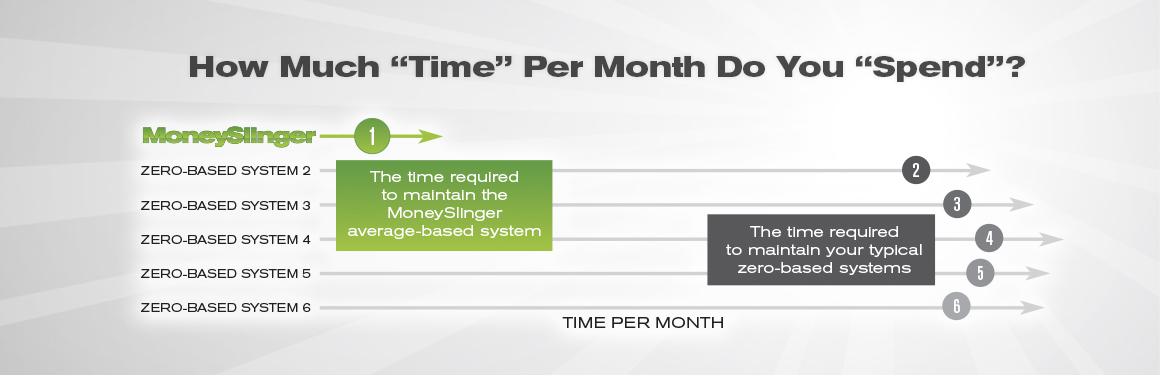


Still Looking For a Fast
and Easy Way to Manage
Your Personal or Family
Household Cashflow?

Hi, I’m Lee Roesner,
Creator of MoneySlinger
I’ve got a system so fast and easy,
that I can afford the time to manage
your money for you…
For Free.
Could It Get Any Faster
or Easier Than That?
No, I’m Not Crazy
And no, this is not a scam.
Because no, I won’t be managing your
money ~ for free or otherwise.
I wanted you to experience,
~ for just a moment ~
just how fast and easy,
fast and easy can be.
Because this level of fast and easy
is my benchmark offer to you,
and why it’s worth your time
to read a bit further.
First, Why Trust Me?
I live and have a Graphic Design business
I’ve run for some 19 years in northern Illinois just
outside Chicago. Here’s my Linkedin profile.
Take note of the recommendations.
You see, I’m a lazy perfectionist ~ and a
creative, which makes me a bit of an inventor,
and like you, my TIME is precious
not to mention my MONEY.
But do not assume this is a quickie,
made-for-the-internet invention,
or just some elaborate checkbook
balancing software on steroids.
You see, I ended up cracking wide open
the “root problem” of money management
back around 1985 to the degree mentioned
above, allowing me to automate
nearly then entire process.
Only problem was,
I didn’t know it.
What happened?
In hindsight.
Our money management
problem quietly went away.
Unnoticed.
Nearly invisible, our life went on and my wife
and I unknowingly used this little paper and
pencil “thing”, twice a month for some 15 years,
while effortlessly maintaining a
FICO score hovering around 820.
All the while, if you recall, Oprah was
having her personal finance shows, with the crying
couples all trying so hard, and we still have the
many news shows today with the cute budgeting
“tips and tricks” segments ~ and the
how-to books…so many books!
All great stuff.
But the time! The effort!
So much to know. So much to do.
We kept saying to ourselves
“What’s the problem?”
But then again, as often as we might
have personally tried to show people
a way out their financial drudgery ~ if they
happen to ask, many had a difficult time getting
out of their current mental paradigm
of elementary bean counting.
Over the years, this became the
twilight zone to us ~ and here we are
some 30 years later, and it still is.
Back then (as now) this grew into a
longstanding joke for us and so I began
creating satire to reflect this
alternate universe and started selling
a simple windows app called The B Word.
But still, in hindsight again,
I apparently was still clueless at what I
had created, and after some 15 years of nearly
invisible effort and a perfect FICO score,
because I attempted to dump
my little money management system in 1999
for a bright, shiny and new “real”
money management software package.
Four hours later…
that’s when the lights went on.
I had totally forgotten what traditional
money management was like: the time and
effort needed to maintain order; to attempt reach
budget goals each month; and where one
or two budget mishaps would cascade
and effect my entire plan, that again would
increase my time and effort to “save”
my plan and myself, while the next budget
mishap was surely just around the corner.
I had none of that.
Why?
Then the question appeared.
“What in the world have I been doing
for 15 years, that is nearly invisible
and with total success?
OK, So What’s MoneySlinger?
x
x
x
x
x.
Here’s What I’ll Need You To Do
(click tab to see details)
So What’s Your Responsibility In This Deal?
If you’ve read the details of what’s required above,
you’ll know that I’ll end up managing approximately
80% of your entire cashflow volume.
Your only money management responsibility now
is to contribute the SAME amount to me
on the SAME two dates each month
~ I’ll take care of the rest.
Is that fast and easy enough?
Your 2 identical payments ~ made on 2 identical dates
essentially pay every one of your numerous individual
expenses each month and will take care of some 80% or
more of your most important life expenses.
Could it get any easier?
Well, actually it can.
How About That Other 20%?
That other 20% is what you’ll be managing,
but that 20% is not just any percent.
It’s a balance…and that balance is
the difference between what you earned
that pay period, and your average monthly
expense you’re paying me to cover
all your “must have” expenses.
Which means, if you have variable income,
that 20% is sometimes 10%, or 15%…or 25%
~ it’s whatever’s left.
It also means this balance is sitting
all by its lonesome self in its own bank
account, physically separated from
your “must have” money.
Which also means when you open
up your daily checkbook or look at your
online bank account, that “must have”
money is not there either
~ just whatever’s left.
Which means the only daily
“budgeting” or “tracking” you’ll have to
do is to make sure you don’t run out
of money before your next pay period
~ where you’ll pay me first.
I think that’s about it.
Everything else is taken care of.
Really. Think about it.
What else is there?
It makes for easy daily decision
making on your end, doesn’t it?
What Will I Be Doing?
Being the lazy perfectionist I am, I’ll
be doing as little as possible ~ perfectly.
Fortunately, I have a little program I
developed around mathematical averaging.
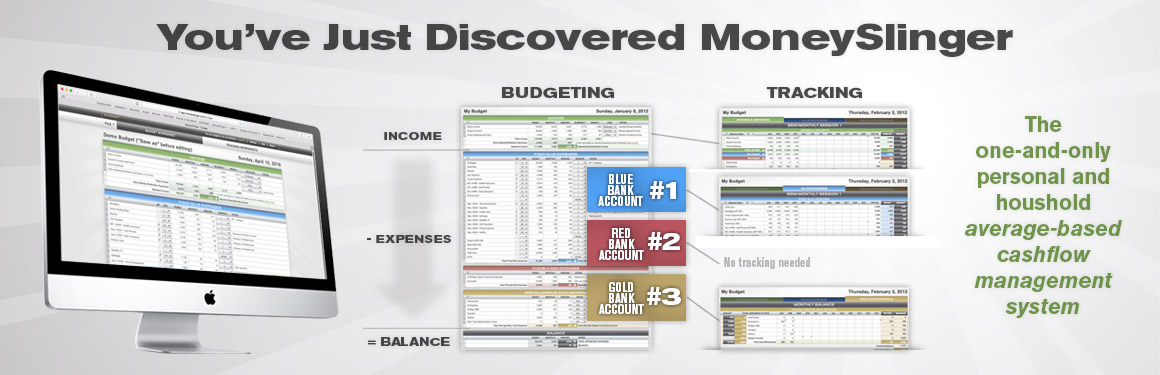
As a matter of fact it has a Budget Worksheet
that does for you, what you just manually did above
that determines your payment amount to me.
It also has a Deposit Tracking Worksheet that tracks
your income; that then subtracts that deposit payment
to me; which determines the deposit balance to you.
But key to my task, is the Expense
Worksheet where I track only the
“must have” expenses you’ve determined you
must financially meet in your life.
But, it does a bit more than just track each
expense payment made each month, it
continually calculates a monthly running average
for each through the year, and compares this
“actual” running average side-by-side
next to the “estimated” average
you determined earlier.
I should also mention it has a
Savings Worksheet as well should you
decide to dedicate some of your money for
future goals that may be a little more long term.
I can handle that for you as well.
And I think that’s it.
No, There’s More
Or should I say, less?
If you recall, your deposit to me will be
deposited in your own, dedicated bank
account in your name.
And I forgot to mention above, that
the Expense Tracking Worksheet not only
calculates a running average through the
year for each individual expense,
it also totals all these individual payouts
into a single monthly “actual” average, and
compares it to the “estimated” deposit
payment you’re making to me.
Still with me?
You see, the thing about averaging
when used in combination with a dedicated bank
account, is all the variability of individual monthly
expense amounts you normally have to contend
with ~ actually cancel each other out.
That’s to say, if one payment is higher than
your average estimate in a particular month, it’s
compensated for in the bank account by another expense
payment that is under your average estimate.
The more variable items you put into this
dedicated account, the less variabilty there is
in the actual balance of the account.
Get it?
So while I may be tracking your individual
expenses, it’s now OK if they float over and under
your average estimate in a particular month,
(to a particular degree of course).
What becomes important then, is not so
much each individual expense figure
~ but your total average expense.
And so my financial focus on our account
is not on the trees, but is on the forest
~ which is a single figure.
Get it more?
So even if some of your expenses are
seasonly variable, your deposit stays
the same all year long.
So the money you may payout in say, summer,
that is “under” your estimated annual average
accumulates in the dedicated
bank account, and is there in winter when
your average payout is “higher” than
your annual average.
Are you getting how easy my job is?
Well, It Gets Easier
Yea, can you believe it?
You have to remember, your
semi-monthly deposit to me is
essentially “payment in full”
for each half month’s expenses.
What this means is not only is your
personal calculation effort at near zero
each month, by simply balancing your
checkbook, but my own calculation
efforts are at near zero as well.
What’s to calculate?
What’s to decide?
There is only to track and confirm.
So my job now is to lighten my
administrative load even more and to automate
my payment process as much as possible.
That means I’ll set up as many autopayments
as I may want because I am 100% sure there
is money in the bank account to cover them.
(Remember we still have the
10% cushion in the account as well)
So How Do I Make Money?
I setup the autopayments using
my own credit card. Not only am I sure I
can pay it off in full with your deposit when
it’s due…but I’ll gain all the free points
and prizes and beat the credit card
companies at their own game.
If you don’t mind.
(note: not sure how to close yet…)